

Buying Banana Powder in Bulk: Complete Guide for Importers and Distributors
Buying banana powder in bulk is not simply about finding the lowest price per kilogram. For importers, distributors, food manufacturers, wholesalers, nutritional-product companies, and private-label businesses, the bigger challenge is finding a product that matches the required application, remains consistent between batches, arrives in suitable packaging, and comes with the documentation needed for commercial supply.
That is why bulk banana powder sourcing should be treated as a supplier and product evaluation process rather than a simple price comparison.
This guide explains what buyers should check before purchasing banana powder in bulk, how to compare suppliers, which specifications matter, what questions to ask before placing an order, and how to reduce common sourcing risks.
What Is Banana Powder?
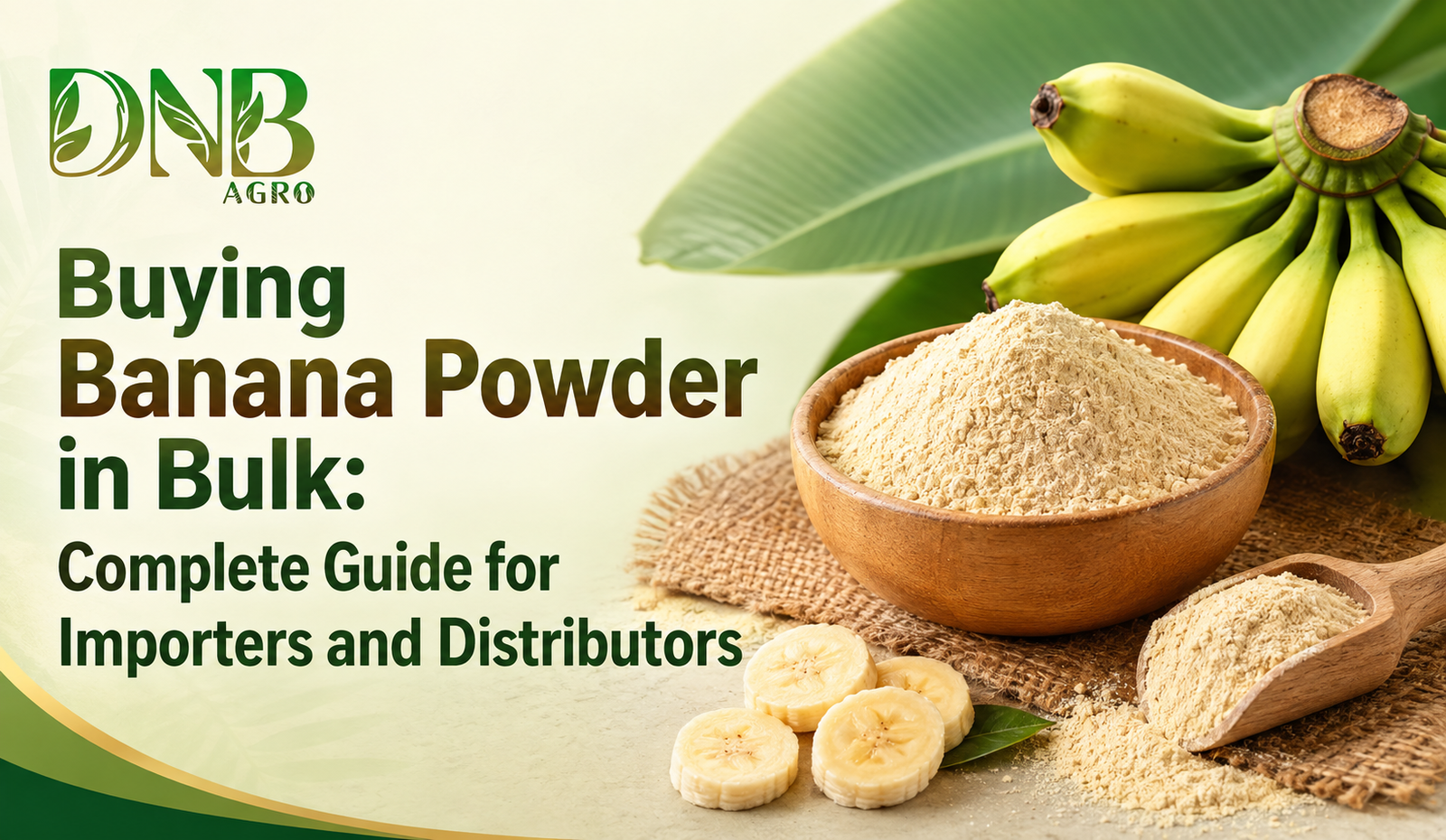
Banana powder is a powdered ingredient produced by processing bananas through stages such as raw-material selection, preparation, drying, milling, and sieving.
The final characteristics can vary depending on the banana variety, maturity, drying conditions, processing method, and intended application.
For commercial buyers, "banana powder" is therefore not a complete specification.
Before requesting quotations, define what you actually need. This may include the raw material, colour, aroma, moisture, particle size, shelf life, packaging, testing requirements, and intended use.
A powder suitable for one food formulation may not deliver the same performance in another, so application requirements should be established before purchasing.
Why Businesses Buy Banana Powder in Bulk
Bulk banana powder can be useful when businesses need a convenient, dry ingredient for repeat production or distribution.
Common commercial applications can include bakery products, dessert formulations, nutritional products, beverage mixes, dry premixes, food manufacturing, ingredient blending, and private-label products.
For manufacturers and distributors, powdered ingredients can simplify storage, weighing, transport, and formulation compared with fresh fruit.
The commercial value, however, depends on consistency. If moisture, particle size, colour, or flavour varies significantly between batches, the powder can create problems further down the production line.
What Should You Look for in Bulk Banana Powder?
A professional buyer should request a written product specification before discussing a large purchase.
Moisture
Moisture is a key consideration in powdered ingredients because it can influence flowability, storage behaviour, stability, and microbiological risk.
The right specification depends on the product and its intended application. Rather than asking whether a supplier's powder is simply "low moisture," ask for the actual specification and the method used to verify it.
Particle Size
Particle size affects how banana powder behaves during mixing, blending, filling, and other processing steps.
Ask the supplier whether a defined mesh size is available, whether the powder is sieved after milling, and whether particle size can be adjusted to the buyer's application.
Colour
Colour can matter when banana powder is used in consumer-facing products or formulations where visual consistency is important.
Buyers should ask how colour is specified and how natural variation is managed rather than relying on vague terms such as "premium" or "high quality."
Aroma and Flavour
The powder should have characteristics appropriate to the raw material and intended application.
Clarify the expected aroma and flavour profile and whether those characteristics may vary because of raw-material or seasonal differences.
Microbiological and Contaminant Testing
Food ingredient buyers may require testing for parameters such as total plate count, yeast and mould, coliforms, E. coli, and Salmonella. Depending on the product, market, and buyer requirements, heavy metals and pesticide residues may also need to be assessed.
The testing panel should be agreed before production, especially for export orders.
Looking for banana powder for commercial use? Explore our Banana Powder product page to review the product and discuss your required quantity, specifications, packaging, and supply requirements with DNB Agro.
How to Evaluate a Banana Powder Supplier
Finding a banana powder supplier is easy. Finding one that can support repeat commercial supply is much more important.
Start with these five areas.
1. Product consistency
Ask how the supplier controls important characteristics from one batch to another.
Defined specifications are more useful than purely subjective descriptions. A supplier should be able to explain what is measured and what limits apply.
2. Manufacturing controls
Understand how the powder moves from raw material to finished product.
Ask about raw-material inspection, cleaning, drying, milling, sieving, quality inspection, packing, and batch identification.
A supplier that can explain the process clearly gives the buyer a better basis for qualification.
3. Testing and documentation
Ask what testing is performed and whether batch-specific documentation can be supplied.
Depending on the market and transaction, this may include a Certificate of Analysis, product specification sheet, Certificate of Origin, commercial invoice, packing list, batch information, and other food-safety or export documents.
4. Packaging
Packaging needs to protect the powder during storage and transportation.
Ask what bag sizes are available, whether an inner liner is used, how moisture is controlled, what appears on the label, and how batch identification is handled.
5. Supply capability
A supplier may be able to fulfil a trial order but struggle when demand increases.
Ask about MOQ, monthly capacity, standard lead time, repeat-order scheduling, and how the supplier handles growing demand.
For importers and distributors, supply continuity can be just as important as the initial product sample.
Have specific sourcing requirements? Contact DNB Agro with your required quantity, application, packaging needs, destination, and product specifications to discuss your bulk banana powder requirements.
What Is the Right MOQ for Wholesale Banana Powder?
MOQ, or minimum order quantity, varies by supplier, packaging format, product specification, and production economics.
A trial quantity can make sense when a buyer is qualifying a new supplier. A larger commercial order may become more practical after the product has been tested and approved.
Do not judge MOQ in isolation. A low MOQ is not automatically a better commercial option if the supplier cannot maintain the quality, packaging, documentation, or lead time your business needs.
How to Compare Banana Powder Prices
Price per kilogram is important, but it should never be the only comparison point.
Two wholesale banana powder quotations may differ because of product specification, testing scope, packaging, order quantity, freight terms, documentation, payment terms, or lead time.
For importers, the real comparison is landed cost rather than supplier price alone. Freight, customs-related costs, duties or taxes, inland transportation, storage, and handling can affect the final economics.
A useful question is:
What exactly am I receiving for this price, and will the product perform consistently in my application?
That approach makes supplier comparisons much more meaningful.
Buying Banana Powder from India
For buyers looking for a banana powder supplier in India, product capability and export readiness should be evaluated together.
Before placing an order, confirm the manufacturing location, product specification, testing, packaging, MOQ, production capacity, lead time, export documentation, and shipping arrangements.
Destination-country requirements should also be established in advance.
For example, food imported into the United States is subject to requirements administered by the U.S. Food and Drug Administration, while food placed on the EU market is subject to the applicable European food-safety framework. Importers should verify current requirements with the relevant authorities, customs professionals, or regulatory advisers for their specific product and destination.
Questions to Ask a Banana Powder Supplier Before Buying
A serious commercial enquiry should contain more than, "Please send your best price."
Ask:
Is the banana powder manufactured in-house?
This helps determine whether you are dealing directly with a manufacturer, distributor, or intermediary.
Can you provide a written specification?
The document should clearly identify the relevant product parameters.
Can you provide a batch-specific Certificate of Analysis?
Batch-specific documentation is useful when qualifying a shipment.
What packaging is available?
Confirm bag size, material, inner liner, labelling, and moisture protection.
What is the MOQ and normal lead time?
Also ask whether trial quantities and repeat orders have different terms.
What is your production capacity?
This helps determine whether the supplier can support growth.
Which markets do you already supply?
Relevant export experience can be useful for international buyers.
How are quality complaints handled?
A dependable supplier should have a clear process for investigation and corrective action.
Common Mistakes When Buying Bulk Banana Powder
Choosing only on price
The cheapest quotation may come with a different specification, weaker packaging, less documentation, or less reliable supply.
Not defining the application
Suppliers need to understand how the powder will be used. Bakery, beverage, nutritional, and dry-mix applications may have different requirements.
Ordering a large quantity before qualification
A large first order creates unnecessary risk if the powder has not yet been tested in the intended formulation or distribution environment.
Ignoring packaging
A product can meet its specification and still create commercial problems if the packaging is not suitable for storage and transport.
Assuming all banana powders are interchangeable
They are not. Differences in colour, moisture, particle size, flavour, processing, and raw material can affect performance.
Leaving documentation until the shipment stage
For international trade, documentation should be discussed before the purchase order and aligned with the destination market.
A Practical Supplier Qualification Process
A structured qualification process can make sourcing more reliable.
Step 1: Define the specification
Write down the product, application, quantity, packaging, testing, and delivery requirements.
Step 2: Shortlist suppliers
Evaluate manufacturers and suppliers based on product suitability, process controls, documentation, and commercial capability.
Step 3: Request a sample or trial quantity
Where practical, test the powder in the actual formulation or business application.
Step 4: Review documentation
Check the specification sheet, relevant test reports, batch details, packaging information, and required commercial or regulatory documents.
Step 5: Review the commercial terms
Compare MOQ, pricing, lead time, payment terms, packaging, freight terms, and delivery responsibilities.
Step 6: Approve the supplier
Once technical and commercial requirements are met, move into a defined purchasing process.
Step 7: Monitor repeat batches
Supplier qualification should not end after the first successful shipment. Repeat orders should continue to be checked against the approved specification.
Why Batch Consistency Matters
A good sample proves that one batch looked suitable. It does not automatically prove that future batches will perform in the same way.
For commercial buyers, the more important question is whether the supplier can reproduce the required specification at the volume and frequency you need.
That is why batch identification, defined specifications, process control, testing, and repeat-order performance matter.
For manufacturers, consistency can reduce unnecessary formulation adjustments. For distributors, it can help maintain confidence in the product supplied to their own customers.
A Look at DNB Agro's Bulk Supply Approach
For buyers evaluating a banana powder supplier in India, DNB Agro provides an example of the information a supplier should be willing to disclose.
DNB Agro, operated by Terrablend Agro Food Processing Private Limited, manufactures fruit, vegetable, spice, and superfood powders for commercial and bulk applications.
Its stated manufacturing process covers raw-material selection, cleaning and sorting, controlled drying, milling and sieving, quality inspection, and secure packing.
According to the company information provided for this article, DNB Agro has an estimated combined processing capacity of approximately 75 metric tonnes per month, including approximately 6 metric tonnes of banana powder capacity.
The company also states that it supports batch traceability, laboratory testing, bulk packaging, export documentation, and recurring commercial supply.
Buyers should confirm current banana powder specifications, availability, MOQ, testing documentation, packaging, and production schedules directly before placing an order.
Buyers looking for a commercial supply option can explore DNB Agro's Banana Powder to learn more about the product before requesting pricing and availability for their requirements.
What to Include in a Bulk Banana Powder Enquiry
A strong enquiry helps suppliers provide a quotation that can actually be evaluated.
Include:
-
Required quantity
-
Delivery country and location
-
Intended application
-
Preferred product specification
-
Packaging requirement
-
Required testing
-
Target delivery date
-
Documentation needs
-
Expected repeat-order volume
The more specific the enquiry, the easier it becomes to compare suppliers fairly.
For distributors and importers, sharing expected monthly or quarterly demand can also help a supplier assess whether the relationship can be supported on a recurring basis.
The Best Way to Choose a Banana Powder Supplier
The strongest supplier decision rarely comes from one impressive number.
A more useful framework is:
Product fit + Quality + Consistency + Documentation + Packaging + Supply capability + Total cost
A supplier that performs well across these areas is generally more valuable than a supplier offering only a low opening quotation.
For businesses planning regular imports or distribution, this broader evaluation can also reduce preventable quality, logistics, and supply problems later.
Before Placing Your First Bulk Order
Before sending a purchase order, confirm:
-
Exact product specification
-
Intended application
-
Moisture requirement
-
Particle-size requirement
-
Relevant testing
-
Packaging and inner liner
-
MOQ
-
Lead time
-
Production availability
-
Batch traceability
-
Required export documents
-
Sample or trial approval, where applicable
-
Total landed cost
-
Destination-market requirements
-
Agreed commercial terms
A careful qualification process takes more effort at the beginning, but it can prevent expensive problems after the shipment arrives.
Ready to source banana powder in bulk? Contact DNB Agro with your required quantity, destination, application, packaging, and testing requirements to discuss availability, MOQ, lead time, and quotation details.
Frequently Asked Questions
1. Where can I buy banana powder in bulk?
Bulk banana powder can be sourced from manufacturers, specialist ingredient suppliers, exporters, wholesalers, and distributors. The right option depends on your required quantity, specification, application, destination, documentation, and need for recurring supply.
2. What should I check before buying wholesale banana powder?
Check the product specification, moisture, particle size, colour, aroma, microbiological requirements, shelf life, packaging, MOQ, testing documentation, lead time, and supplier production capability. Importers should also confirm destination-market requirements.
3. Is it better to buy directly from a banana powder manufacturer?
Buying directly from a manufacturer can provide greater visibility into processing, specifications, batch traceability, and production capacity. However, a distributor or trader can also be suitable when it provides dependable sourcing and documentation. Evaluate the actual supplier capabilities rather than relying only on the business category.
4. What is the MOQ for bulk banana powder?
There is no universal MOQ. It depends on the supplier, packaging, product specification, production economics, and order size. Ask about trial quantities as well as recurring commercial quantities.
5. What documents should an importer request?
Depending on the destination and transaction, buyers may request a product specification, Certificate of Analysis, commercial invoice, packing list, Certificate of Origin, batch information, and applicable food-safety or export documents. Requirements should be confirmed for the specific destination.
6. How do I choose a banana powder supplier in India?
Evaluate the supplier's product specification, manufacturing process, testing, packaging, MOQ, production capacity, export documentation, lead time, communication, and repeat-order capability. A sample or trial order can be valuable before committing to larger quantities.
7. Can banana powder be supplied on a recurring basis?
Yes. Many commercial ingredient suppliers support repeat purchasing arrangements. Before committing, confirm production capacity, standard lead time, packaging, approved quality specifications, and how repeat batches are controlled.