

Spinach Powder Uses: 10 Ways It Is Used in Food and Beverage Products
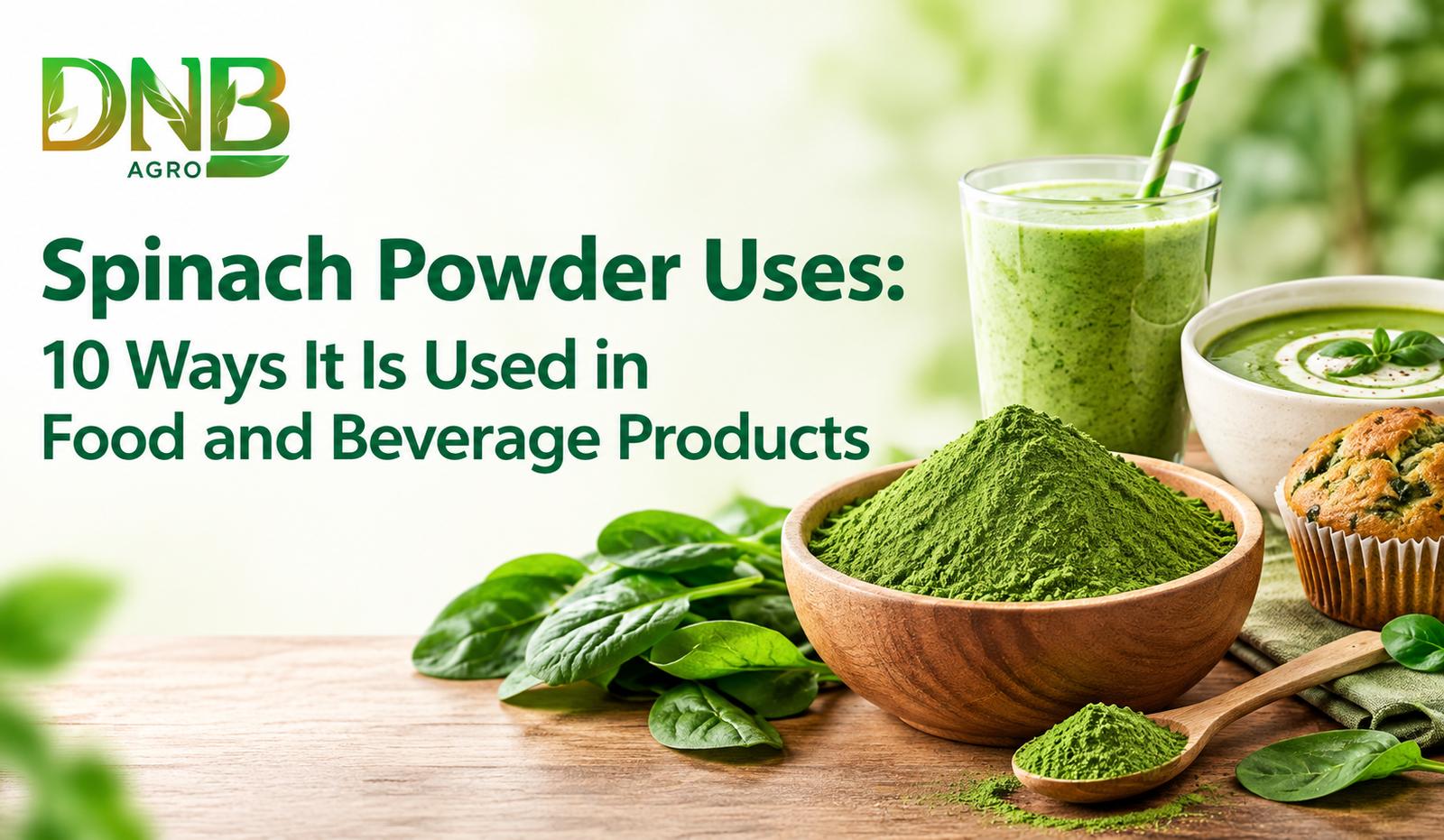
That makes spinach powder useful across product categories such as pasta, bakery products, soups, sauces, seasonings, snacks, smoothies, drink mixes, prepared meals, and nutritional formulations. It can contribute vegetable character, green color, and spinach flavor while fitting into dry blends and other controlled formulations.
For product developers, R&D teams, procurement managers, and food manufacturers, the important question is how the ingredient performs in the finished product, how easily it can be incorporated, and whether the supplier can provide consistent quality from batch to batch.
Why Is Spinach Powder Used in Food Manufacturing?
Fresh spinach brings water, handling, storage, and preparation requirements. A dried spinach ingredient gives manufacturers a more convenient powdered format for repeat production.
Spinach powder can be easier to weigh, blend, store, and distribute through dry formulations. Its fine form can also be practical where fresh leafy material would be difficult to incorporate consistently.
The exact inclusion level depends on the product, desired color and flavor, processing conditions, and supplier specification. There is no universal dosage.
10 Spinach Powder Applications in Food and Beverage Products
1. Pasta and Noodles
Spinach powder can be incorporated into pasta and noodle doughs to create a spinach-based product profile and green appearance. It is particularly useful in dry formulations because the powder can be mixed with flour and other dry ingredients before hydration.
For manufacturers, the attraction is consistency. A standardized powdered ingredient can be easier to portion across repeat production than fresh spinach, whose moisture and physical condition can vary.
2. Bakery Products
Bread, crackers, savory biscuits, bakery mixes, and other baked products can use spinach powder as part of a vegetable-based formulation.
It may be blended into the dry ingredients before mixing. The formulation team then evaluates dough behavior, color, flavor, texture, and finished appearance.
3. Soups and Soup Mixes
Spinach powder works well in dry soup mixes, instant preparations, and other savory powdered products where ingredients need to disperse through a controlled blend.
Manufacturers can use it alongside other vegetables, herbs, spices, and seasoning components. Particle size, moisture control, and blending behavior matter because the powder needs to distribute consistently throughout the finished mix.
4. Sauces, Dips, and Dressings
Spinach powder can be used in sauces, dips, spreads, and dressings where a spinach profile or green vegetable ingredient is desired.
The powder can be incorporated during blending, but formulators need to consider hydration, viscosity, color development, and flavor. In wet products, compatibility with the rest of the formulation becomes especially important.
5. Seasoning and Spice Blends
Seasoning manufacturers can add spinach powder to savory blends intended for snacks, ready-to-cook foods, noodles, or other prepared products.
Here, spinach powder functions as one component of a larger dry ingredient system. Uniform particle size and consistent moisture can help with blending and distribution, especially when the finished seasoning is used in repeat commercial batches.
6. Savory Snacks
Spinach powder can be incorporated into snack seasonings, baked snacks, crackers, extruded products, and other savory formulations.
It can support a vegetable-based product concept without requiring fresh spinach during manufacturing. Depending on the application, formulators may combine it with cheese notes, herbs, spices, or other vegetable powders to create a specific flavor profile.
7. Smoothies and Drink Mixes
Spinach powder can also be used in smoothies, powdered beverage mixes, and nutritional drink formulations.
For beverages, dispersion and sensory performance deserve particular attention. Manufacturers should evaluate dispersibility, sedimentation, flavor, color, and mouthfeel in the finished drink.
8. Nutritional and Wellness Products
Spinach powder may be included in nutritional blends, greens products, meal-related formulations, and other wellness-oriented products where a vegetable ingredient fits the product concept.
The commercial priority remains formulation compatibility and specification control. Product developers should verify quality documentation and the claims permitted for the final product.
9. Ready-to-Eat and Prepared Foods
Prepared meals, instant foods, savory premixes, and ready-to-eat products can use spinach powder as part of a broader vegetable or seasoning system.
Its powdered form can simplify ingredient handling at scale, provided the powder's specifications match the process and final product requirements.
10. Functional and Specialty Food Formulations
Spinach powder can find a place in specialty foods where developers want to combine vegetable ingredients with a particular product format.
Examples can include plant-focused dry blends, specialty snack concepts, meal mixes, and other formulations built around vegetables or leafy-green ingredients. The key is to treat spinach powder as a formulation ingredient rather than assuming that simply adding it will deliver the desired result.
What Are the Manufacturing Benefits of Spinach Powder?
The main advantages are practical. Spinach powder provides a dried, portionable format that can be easier to handle than fresh spinach in many commercial environments.
Manufacturers may value:
- Easier storage and handling
- More convenient weighing and batching
- Straightforward incorporation into dry blends
- Consistent physical form for repeat production
- Reduced preparation compared with fresh leafy ingredients
- Suitability for a broad range of food and beverage formulations
These advantages do not remove the need for application testing. Developers still need to evaluate color, flavor, moisture, particle size, microbiological quality, packaging, and storage conditions.
What Should Food Manufacturers Check When Choosing Spinach Powder?
A good spinach powder is more than a green powder in a bag. Buyers should understand the specification behind it.
Start with appearance, color, aroma, moisture, particle size, purity, microbiological parameters, shelf life, packaging, and storage requirements.
For commercial procurement, ask whether the supplier can provide a product specification, batch identification, and Certificate of Analysis where applicable. Traceability matters when an ingredient is used across repeat production runs.
Also separate spinach powder from spinach extract, flakes, or leafy-green blends. These ingredients are not automatically interchangeable.
Choosing a Reliable Bulk Spinach Powder Supplier
For a B2B buyer, the supplier relationship matters almost as much as the ingredient itself. A manufacturer may approve a powder during one trial and still face problems later if moisture, particle size, color, packaging, or documentation varies between lots.
DNB Agro's stated manufacturing approach is built around controlled drying, milling, sieving, quality checks, batch traceability, food-grade packaging, and bulk supply across its vegetable powder portfolio. The company also describes internal and external quality testing, commercial packaging options, export documentation, and repeat-order support.
For buyers evaluating spinach powder sourcing, those are the same operational areas worth discussing before placing a commercial order. Availability, exact product specification, MOQ, packaging, testing documentation, and application suitability should be confirmed directly for the spinach powder grade required.
Frequently Asked Questions About Spinach Powder Uses
1. What is spinach powder used for?
Spinach powder is used as a dried vegetable ingredient in products such as pasta, bakery items, soups, sauces, seasonings, snacks, smoothies, drink mixes, prepared foods, and nutritional formulations.
2. Can spinach powder be used in beverages?
Yes. It can be used in smoothies, powdered drink mixes, and other beverage formulations. Developers should test dispersion, flavor, color, sedimentation, and mouthfeel in the actual beverage system.
3. Can spinach powder be used in pasta and noodles?
Yes. It can be blended with flour and other dry ingredients before hydration. The formulation should be tested for color, flavor, dough behavior, and finished texture.
4. Why use spinach powder instead of fresh spinach?
For many commercial formulations, the powdered format is easier to weigh, store, blend, and dose than fresh leafy spinach. The right choice still depends on the product and processing system.
5. How much spinach powder should be used in a formulation?
There is no universal inclusion rate. The appropriate level depends on the product, desired sensory characteristics, processing method, and the supplier's specification. Application trials are the safest way to determine the right level.
6. What should I ask a spinach powder supplier?
Ask for the product specification, available pack sizes, MOQ, moisture and particle-size information, microbiological testing, batch traceability, shelf-life and storage details, Certificate of Analysis where applicable, and confirmation that the grade suits your intended application.
Final Takeaway
Spinach powder is useful because it converts a leafy vegetable into a practical ingredient format for commercial food and beverage development. Its applications range from pasta and bakery products to sauces, seasonings, snacks, beverages, prepared foods, and specialty formulations.
For manufacturers, the best sourcing decision is not simply about finding spinach powder. It is about finding a food-grade ingredient that fits the formulation, arrives with appropriate documentation, and can be supplied consistently as production grows.
That is where a supplier's processing controls, quality checks, traceability, packaging, and fulfilment capabilities start to matter. Businesses exploring bulk spinach powder sourcing can approach DNB Agro to discuss the required specification and commercial supply needs.