

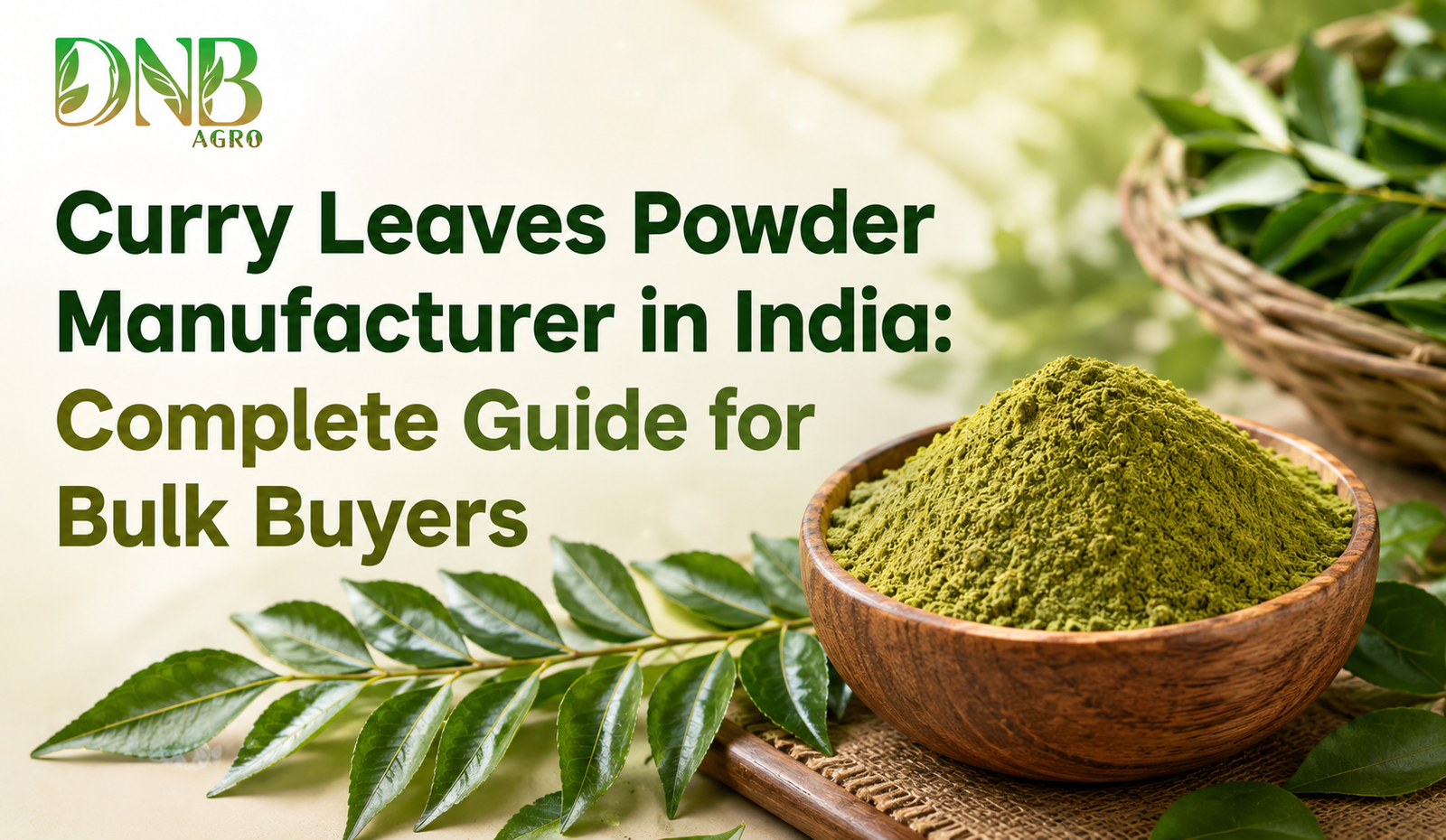
Curry Leaves Powder Manufacturer in India: Complete Guide for Bulk Buyers
Buying curry leaves powder in bulk is not simply about finding the lowest price per kilogram. For food manufacturers, importers, distributors, wholesalers, private-label brands, and other commercial buyers, the bigger question is whether the manufacturer can deliver a consistent ingredient with suitable processing, packaging, documentation, and dependable supply.
Curry leaves powder is made from dried curry leaves (Murraya koenigii) and is used in spice blends, seasonings, savoury foods, ready mixes, and other commercial food formulations. When sourcing from India for the U.S. or other international markets, buyers should evaluate both the product and the supplier behind it.
This guide explains what to check before choosing a curry leaves powder manufacturer in India, how bulk procurement works, and what international buyers should clarify before placing an order.
What Is Curry Leaves Powder?
Curry leaves powder is produced by cleaning, drying, grinding, and sieving curry leaves into a powdered ingredient.
For commercial applications, consistency matters. Raw-material quality, drying, moisture control, particle size, cleanliness, packaging, and storage can all influence the finished powder's performance.
A good supplier should therefore be able to explain how the product moves from raw material to finished powder and how quality is checked along the way.
What to Look for in a Curry Leaves Powder Manufacturer in India
1. Controlled raw-material selection
Quality starts with the raw material. Ask how curry leaves are selected and inspected before processing.
A manufacturer should have a defined process for identifying unsuitable, damaged, or contaminated material rather than allowing inconsistent raw material into production.
2. Proper cleaning and preparation
Curry leaves can pick up dust, soil, and foreign matter during harvesting and transportation. Cleaning and sorting are therefore essential steps before drying.
Ask the supplier how incoming material is cleaned and what controls are used to remove unwanted matter.
3. Controlled drying
Drying reduces moisture while helping preserve the characteristics required for the finished ingredient.
Buyers should ask whether drying conditions are controlled and whether the final moisture level is checked against a product specification. Do not assume that every supplier uses the same drying process or achieves the same result.
4. Milling and sieving
After drying, the leaves are ground into powder and may be sieved for more consistent particle size.
Particle size can affect blending, flowability, texture, and formulation performance. The appropriate specification depends on the buyer's application, so confirm the required particle size before ordering.
5. Quality testing
Commercial buyers should understand which quality and safety parameters are checked.
Depending on the product and destination, these may include moisture, appearance, aroma, foreign matter, particle size, and microbiological parameters. The buyer should request the current specification and applicable test documentation rather than relying on generic claims.
6. Packaging and batch traceability
Powdered ingredients need protection from moisture, contamination, and rough handling.
Ask about food-grade packaging, inner liners, bulk pack sizes, storage conditions, batch coding, and product labelling. Batch identification is particularly useful when managing repeat orders or investigating a quality issue.
Who Buys Curry Leaves Powder in Bulk?
Bulk curry leaves powder can be relevant to several B2B buyers.
Food manufacturers may use it in savoury products, seasoning systems, sauces, instant mixes, and other formulations.
Spice and seasoning companies may include curry leaves powder within blended products where consistent aroma and particle size are important.
Ingredient distributors and wholesalers typically need dependable packaging, documentation, and repeat supply in addition to acceptable product quality.
Importers need to evaluate the manufacturer's export capability, documentation, logistics, and communication.
Private-label businesses may have additional requirements for packaging, labelling, specifications, and order coordination.
The right supplier is therefore not necessarily the one offering the cheapest first shipment. It is the one that fits the buyer's complete sourcing requirement.
How to Evaluate Curry Leaves Powder Before a Bulk Purchase
Before moving from an enquiry to a large order, assess the product against your own requirements.
Check the powder's:
-
Appearance and consistency
-
Characteristic aroma
-
Moisture specification
-
Particle-size requirement
-
Foreign-matter controls
-
Applicable microbiological parameters
-
Packaging format
-
Shelf-life information
-
Batch identification
-
Relevant quality documentation
A sample can help assess whether the product fits your formulation, but repeat procurement requires something more: confidence that the manufacturer can maintain acceptable consistency across commercial batches.
Looking for curry leaves powder for your food, seasoning, distribution, or private-label requirements? Explore DNB Agro’s Curry Leaves Powder to review the product and discuss specifications for your bulk requirement.
Buying Curry Leaves Powder From India for the USA
For U.S. buyers, product quality is only one part of the sourcing process. Import documentation and applicable regulatory requirements also need to be considered.
Before confirming an order, buyer and supplier should clarify:
-
Product specification
-
Packaging and labelling
-
Certificate of Analysis or other applicable documentation
-
Batch details
-
Commercial invoice and packing documents
-
Country-of-origin documentation where applicable
-
Shipping arrangements
-
Responsibilities of exporter and importer
-
Any additional requirements applicable to the shipment
U.S. importers should verify current requirements directly with the relevant authorities, including the U.S. Food and Drug Administration, because requirements can vary by product and shipment.
Questions to Ask a Bulk Supplier
A serious sourcing conversation should cover more than price.
Ask the manufacturer about:
-
Current curry leaves powder specifications
-
Minimum order quantity
-
Available bulk packaging
-
Typical production lead time
-
Shelf life and storage
-
Quality-testing documentation
-
Certifications and registrations
-
Batch traceability
-
Export documentation
-
Shipping options
-
Private-label or custom packaging, if required
-
Repeat-order support
Providing your expected quantity, destination, application, and packaging preference will usually help the supplier give you a more useful quotation.
How Bulk Pricing Should Be Compared
Curry leaves powder pricing can vary according to raw-material costs, processing requirements, quantity, packaging, testing, destination, logistics, and other commercial factors.
For that reason, comparing suppliers only by price per kilogram can be misleading.
A lower-priced powder may create additional costs if its moisture, particle size, aroma, packaging, or batch consistency do not fit your process.
A better question is:
Does the supplier provide the right combination of quality, documentation, consistency, commercial terms, and supply reliability for my application?
Need pricing based on your actual quantity and destination? Contact DNB Agro with your required volume, packaging preference, application, and delivery country to request a customized quotation.
Why Repeat Supply Matters
A good first sample is not the same thing as a dependable supply relationship.
For recurring procurement, buyers should establish clear product requirements before regular ordering begins. Those requirements may cover appearance, moisture, particle size, microbiological criteria, packaging, documentation, and other application-specific parameters.
This gives both sides a clear reference point for future batches.
DNB Agro as a Curry Leaves Powder Manufacturer in India
DNB Agro, operated by Terrablend Agro Food Processing Private Limited, supplies natural fruit, vegetable, spice, and superfood powders for commercial buyers.
Its stated manufacturing approach includes raw-material selection, cleaning and preparation, controlled drying, precision milling, quality evaluation, and secure packaging. The company also works with food manufacturers, distributors, wholesalers, importers, private-label businesses, and other B2B buyers.
DNB Agro supports domestic and international commercial supply, but curry-leaf-specific details should always be confirmed before ordering. Buyers should request the current product specification, MOQ, packaging options, applicable testing documentation, lead time, and quotation for their destination and intended application.
That is a more reliable approach than assuming specifications for another powder apply automatically to curry leaves powder.
If you are currently evaluating suppliers, view DNB Agro’s Curry Leaves Powder for product information, or send your bulk enquiry to discuss MOQ, packaging, documentation, lead time, and export requirements.
How to Start a Bulk Enquiry
A clear enquiry makes supplier evaluation easier.
You can provide:
Product: Curry leaves powder
Quantity: Required order volume
Destination: Country and delivery location
Application: Intended commercial use
Packaging: Preferred bulk format
Requirements: Any specific quality, testing, or documentation needs
Then ask the manufacturer to provide the current specification, commercial terms, lead time, and quotation.
Final Takeaway
Choosing a curry leaves powder manufacturer in India should be based on more than product availability or headline pricing.
Look at the complete supply chain: raw-material selection, cleaning, drying, milling, quality evaluation, packaging, traceability, documentation, and the manufacturer's ability to support repeat orders.
For international buyers, particularly those sourcing for the U.S. market, export coordination and applicable import requirements should be discussed before the order is confirmed.
A manufacturer that can clearly answer these questions gives you a stronger basis for evaluating long-term supply.
For businesses considering DNB Agro, the next practical step is to request the current curry leaves powder specification, available packaging, MOQ, applicable quality documentation, lead time, and quotation based on your actual requirement.
For businesses considering DNB Agro, the next step is to evaluate the product against your actual sourcing requirements. View DNB Agro’s Curry Leaves Powder or contact the team for a bulk quotation with your required quantity, destination, packaging preference, application, and documentation needs.
Frequently Asked Questions
1. Who is a curry leaves powder manufacturer in India?
A curry leaves powder manufacturer processes cleaned and dried curry leaves into a commercial powdered ingredient through controlled drying, grinding, sieving, quality evaluation, and packaging.
2. Can I buy curry leaves powder in bulk from India?
Yes. Indian manufacturers and suppliers can serve bulk and international buyers. The buyer should confirm product specifications, quantity, packaging, documentation, logistics, and applicable destination-market requirements before ordering.
3. What should I check before buying curry leaves powder wholesale?
Check the product specification, moisture and particle-size requirements, quality-testing process, microbiological criteria, packaging, shelf life, batch traceability, MOQ, lead time, and export documentation.
4. What is the MOQ for curry leaves powder?
MOQ varies by manufacturer, quantity, packaging, and customization requirements. It should be confirmed directly with the supplier for the specific order.
5. Can curry leaves powder be exported from India to the USA?
It can be supplied for international trade, but the exporter and U.S. importer should verify the documentation, product, labelling, shipping, and regulatory requirements applicable to the specific shipment.
6. Can DNB Agro supply curry leaves powder to international buyers?
DNB Agro serves domestic and international B2B buyers across its natural powder portfolio. Buyers should confirm current curry leaves powder availability, specifications, MOQ, packaging, documentation, lead time, and destination-specific requirements directly with the company.
7. How can I request a quotation for curry leaves powder?
Share your required quantity, destination, intended application, packaging preference, and any technical requirements with the supplier. This allows the manufacturer to provide a more relevant specification and commercial quotation.