

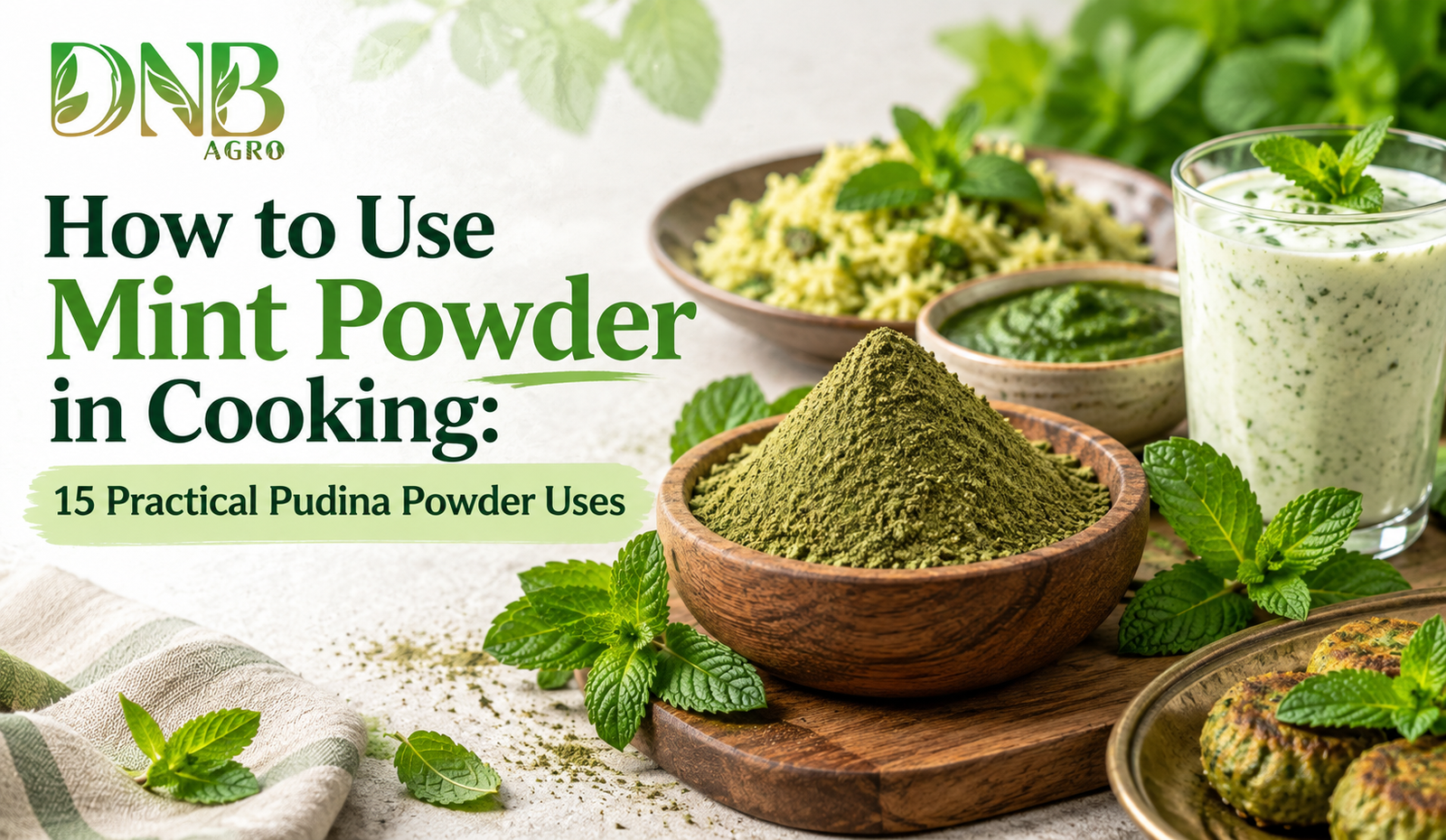
How to Use Mint Powder in Cooking: 15 Practical Pudina Powder Uses
No fresh mint in the refrigerator? That does not mean you have to lose that cool, aromatic flavor.
Mint powder, also called pudina powder or dried mint powder, is dried mint that has been ground into a convenient seasoning. Because the leaves have been dried, their flavor is concentrated, making a small amount useful in everything from curries and rice dishes to yogurt dips, marinades, soups, vegetables, salads, and drinks.
The easiest way to start is simple: use a small amount, mix it evenly, taste, and adjust. For many dishes, starting with about 1/4 to 1/2 teaspoon per serving is a practical approach, although the right amount depends on the dish, the strength of the powder, and the other ingredients.
Here are 15 practical ways to use mint powder in cooking, followed by guidance on quantity, timing, substitution, storage, and choosing a dependable food-grade product.
15 Practical Mint Powder Uses in Cooking
1. Add mint powder to curries
Mint powder can add a fresh, cooling herbal note to savory curries without requiring a handful of fresh leaves.
Stir a small amount into vegetable, chicken, lamb, or bean curries toward the end of cooking. This helps the mint remain noticeable instead of allowing its aroma to disappear during prolonged heating.
It pairs especially well with cumin, coriander, ginger, garlic, chili, and black pepper.
For a mild curry, start with about 1/2 teaspoon for a pot serving four people, then adjust.
2. Season rice and grain dishes
One of the easiest pudina powder uses is in rice.
Add a small amount to cooked rice, pulao, seasoned grains, or other savory rice dishes along with salt, cumin, lemon, or other herbs and spices. You can also mix it into the seasoning before tossing it through the finished rice.
Mint works particularly well when a rice dish needs a little extra aroma without adding moisture.
3. Use it in chicken marinades
Mint and chicken are a natural pairing.
For a simple marinade, combine mint powder with yogurt, lemon juice, garlic, ginger, salt, black pepper, and a little oil. Coat the chicken and allow the marinade to work before grilling, roasting, or pan-cooking.
The dry powder distributes easily through a marinade and can contribute both herbal flavor and aroma.
4. Add it to meat marinades
Mint powder is not limited to chicken. It can also work in marinades for lamb, beef, and other meats where a pronounced herb note complements savory flavors.
Try combining it with garlic, cumin, coriander, black pepper, lemon juice, and yogurt or oil depending on the recipe.
Because mint can become dominant quickly, it is better to begin conservatively and increase the amount after tasting the marinade.
5. Sprinkle it over roasted vegetables
Roasted potatoes, carrots, cauliflower, zucchini, peppers, and other vegetables can benefit from a light dusting of mint powder.
For the most even distribution, mix the powder with salt and other seasonings before tossing it with the vegetables. You can also add a small amount after roasting.
Mint brings a bright contrast to the deeper, slightly caramelized flavors created by roasting.
6. Stir mint powder into yogurt and raita
This is one of the simplest applications for pudina powder.
Mix it into plain yogurt with salt and, depending on the recipe, cumin, black pepper, cucumber, onion, or a little lemon juice.
For raita or a yogurt dip, start with roughly 1/2 teaspoon per cup of yogurt. Let it stand for a few minutes before serving so the dried herb can hydrate and distribute its flavor.
7. Make a quick mint dip
When fresh mint is unavailable, mint powder can form the herbal base of a quick dip.
Mix it with yogurt, mayonnaise, sour cream, or another suitable base, then add lemon or lime juice, salt, garlic, and black pepper.
This works with grilled foods, roasted vegetables, sandwiches, wraps, and snacks.
The key is to add the powder gradually because a dry herb can taste much stronger after it has hydrated.
8. Use it in chutneys and sauces
Mint powder can bring herbal depth to both traditional chutney-style preparations and modern sauces.
It can be mixed with ingredients such as yogurt, lemon, garlic, chili, coriander, or other herbs. In sauces, add it in small quantities and allow a little time for the flavor to develop.
This makes dried mint particularly useful when you want mint flavor without changing the consistency of a sauce.
9. Add mint powder to soups
A small amount can brighten lentil soups, vegetable soups, bean soups, and other savory preparations.
Add it near the later stage of cooking rather than relying on a long simmer to release its flavor. It can be especially useful when a soup tastes heavy and needs a fresh herbal contrast.
Start with a small pinch or about 1/4 teaspoon for a standard pot, then taste.
10. Mix it into salad dressings
Mint powder can turn a basic dressing into something more aromatic.
Whisk it into lemon juice, lime juice, olive oil, yogurt, vinegar, or another dressing base. It works particularly well with cucumber, tomato, leafy greens, chickpeas, roasted vegetables, and grain salads.
Give the dressing a few minutes before serving. This allows the dried mint to absorb some moisture and soften.
11. Season fish and seafood
Mint can add a fresh note to grilled or baked fish when used carefully.
Combine mint powder with lemon or lime, garlic, black pepper, salt, and a little oil. Apply a light coating before cooking, or mix a small amount into a finishing sauce.
For delicate fish, use less mint than you would for a strongly flavored meat or curry. The goal is to complement the seafood rather than cover its natural flavor.
12. Add it to sandwiches and wraps
Mint powder can also work outside traditional cooked dishes.
Mix a small amount into a yogurt spread, creamy sauce, hummus-style dip, or vegetable spread and use it in sandwiches and wraps.
It can add a noticeable herbal layer without requiring fresh leaves that may wilt or release extra moisture into the filling.
13. Season potatoes and savory snacks
Potatoes are particularly forgiving when it comes to dried herbs.
Sprinkle mint powder into roasted potatoes, potato wedges, savory snack mixes, or seasoned fries along with salt, chili, cumin, or black pepper.
Add it lightly at first. Mint should provide a fresh aromatic lift, not dominate the seasoning blend.
14. Add it to beverages and tea
Mint powder can also be used in beverages, although the technique is slightly different from cooking.
For tea, use a small quantity in hot water and strain if needed. For lemon-mint drinks or smoothies, blend a small amount thoroughly so the powder is distributed evenly.
In cold beverages, very fine powder may not fully dissolve. Mixing it first with a small amount of liquid can help prevent clumping.
15. Build a homemade mint seasoning blend
Mint powder does not have to be used on its own.
It can form part of a dry seasoning blend with cumin, coriander, black pepper, chili, garlic powder, salt, or other dried herbs and spices.
This is especially useful for home cooks and food businesses that want a repeatable flavor profile.
For commercial formulations, consistency in flavor, particle size, moisture, and aroma becomes much more important because small changes can affect the finished product.
How Much Mint Powder Should You Use?
There is no single correct amount because dried mint varies in strength, and different dishes need different levels of herbal flavor.
A useful starting point is:
-
1/4 teaspoon: subtle flavor for delicate dishes
-
1/2 teaspoon: noticeable herbal character
-
1 teaspoon: stronger mint flavor for a larger batch or robust recipe
For a first attempt, use less than you think you need. You can add more, but it is much harder to correct a dish that has become overly minty.
For commercial recipes, use a defined formulation rather than relying on casual spoon measurements. Consistent ingredient specifications make repeated production easier.
When Should You Add Mint Powder While Cooking?
Mint powder is flexible, but timing affects the finished flavor.
For curries, soups, and cooked sauces, adding it toward the latter part of cooking often helps preserve its aromatic character.
For rice, vegetables, salads, yogurt, dips, and dressings, it can often be added during final mixing.
For marinades, add it early so it can distribute throughout the mixture and combine with the other seasonings.
There is no rule that says dried mint must always be cooked. In many applications, it is better treated as a finishing seasoning.
Can Mint Powder Replace Fresh Mint?
Yes, in many recipes, although it does not behave exactly like fresh leaves.
Fresh mint contributes moisture, texture, green color, and a brighter leafy character. Powdered mint is much drier and more concentrated, so it is mainly useful when the goal is mint flavor and aroma rather than the appearance of fresh leaves.
A practical substitution is to start with a much smaller quantity of dried powder than the amount of fresh mint called for, then adjust according to taste.
There is no universal fresh-to-dried conversion because the strength of dried mint varies by product and the amount of fresh mint in a recipe can vary considerably.
Mint Powder vs. Dried Mint Leaves vs. Fresh Mint
These ingredients are related, but they serve different purposes.
Fresh mint is best when you want bright aroma, visible leaves, and fresh texture.
Dried mint leaves or flakes are useful when you want a dried herb that still has some leaf structure.
Mint powder is finely ground, so it is easier to distribute through sauces, marinades, spice blends, yogurt, dressings, and seasoning mixes.
Another important distinction is peppermint versus culinary mint. Most savory cooking applications use culinary mint varieties such as spearmint rather than intensely mentholated peppermint. Check the product description and ingredient specification rather than assuming all "mint powder" products are identical.
What Spices Pair Well With Pudina Powder?
Mint is highly versatile because it can play both a supporting and a noticeable aromatic role.
Common pairings include:
Cumin and coriander for savory spice blends and rice dishes.
Garlic and ginger for marinades, curries, sauces, and meats.
Lemon and lime for dressings, marinades, drinks, and seafood.
Black pepper and chili when a recipe needs both freshness and heat.
Yogurt when you want to soften stronger flavors and create a cooling dip or sauce.
Cilantro can also complement mint when a recipe calls for a broader fresh-herb profile.
Common Mistakes When Using Mint Powder
The biggest mistake is simply using too much.
Because dried mint has lost its water content, a small quantity can deliver considerable flavor. Overuse can make a dish taste medicinal, bitter, or overwhelmingly mentholated.
Another common mistake is adding a large quantity at the very beginning of a long cooking process and expecting the same fresh aroma at the end.
Also avoid dumping powder directly into a very wet preparation in one clump. Mixing it first with another dry seasoning, or blending it into a small amount of liquid, can improve distribution.
Finally, old or poorly stored mint powder may have much less aroma than a fresher product. This can tempt you to keep adding more and unintentionally overshoot the desired flavor.
How Should Mint Powder Be Stored?
Store dried mint powder in a tightly closed, moisture-resistant container in a cool, dry place away from direct sunlight.
The main enemies are moisture, heat, air, and light. Exposure can gradually weaken aroma and contribute to clumping.
A practical habit is to keep the container closed between uses and avoid storing it beside a steam-heavy cooking area.
Commercial buyers should also pay attention to packaging. Food-grade bags with suitable inner liners can provide additional protection during storage and transportation, particularly when powders are being purchased in bulk.
What Should You Look for When Buying Mint Powder?
For everyday cooking, freshness and flavor are the priorities.
For businesses purchasing culinary mint powder, the criteria become broader. Buyers may need to consider:
-
Product identity and ingredient declaration
-
Color and aroma
-
Moisture specification
-
Particle size
-
Food-grade packaging
-
Batch identification and traceability
-
Microbiological and other applicable testing
-
Shelf-life information
-
Consistency between commercial batches
-
Supply capacity and documentation
DNB Agro's broader ingredient-supply approach is built around controlled processing, quality checks, batch traceability, food-grade packaging, and support for commercial and bulk requirements. Its portfolio covers fruit, vegetable, spice, and superfood powders for manufacturers, distributors, private-label businesses, and other ingredient buyers.
For any supplier, the important question is not simply whether a powder exists in a catalog. It is whether the supplier can provide the consistent specifications, documentation, packaging, and supply reliability your application requires.
For any supplier, the important question is not simply whether a powder exists in a catalog. It is whether the supplier can provide the consistent specifications, documentation, packaging, and supply reliability your application requires.
Looking for mint powder for commercial or bulk requirements? Explore DNB Agro’s Mint Powder to learn more about the product, specifications, packaging, and supply options.
Final Takeaway
The easiest way to use mint powder is to think of it as a concentrated dried herb and seasoning, not as a one-for-one replacement for a handful of fresh mint leaves.
Use it to bring aroma and flavor to curries, rice, marinades, chicken, meat, fish, vegetables, soups, salads, yogurt, dips, sauces, snacks, and beverages. Start with a modest amount, add it at an appropriate stage, and adjust after tasting.
For home cooks, that makes mint powder a convenient pantry ingredient. For food manufacturers and ingredient buyers, the same ingredient becomes a question of consistency, specifications, testing, packaging, and dependable supply.
That is where supplier quality matters just as much as recipe technique.
For home cooks, that makes mint powder a convenient pantry ingredient. For food manufacturers and ingredient buyers, the same ingredient becomes a question of consistency, specifications, testing, packaging, and dependable supply.
That is where supplier quality matters just as much as recipe technique.
Need pricing, bulk quantity details, documentation, or supply information? Contact DNB Agro to discuss your mint powder requirements with the team.
Frequently Asked Questions
Is mint powder the same as pudina powder?
Yes. In common usage, pudina powder is dried mint powder made by drying and grinding mint leaves. "Pudina" is the commonly used Indian name for mint.
How do you use mint powder in cooking?
Use it as a seasoning in curries, rice, marinades, yogurt dips, raita, soups, vegetables, salads, sauces, meat, fish, snacks, and beverages. Start with a small amount and increase gradually.
How much mint powder should I use?
Start with about 1/4 to 1/2 teaspoon for a typical serving or small preparation, then adjust to taste. The required amount depends on the strength of the powder and the recipe.
Can mint powder replace fresh mint?
It can replace some of the mint flavor, but it will not fully reproduce the fresh leaves' moisture, texture, and bright appearance. Use a smaller quantity of dried powder and adjust as needed.
When should you add mint powder while cooking?
For soups, curries, and sauces, adding it later in cooking can help retain more aroma. For yogurt, salads, rice, and dips, it can often be mixed in near the end.
How should mint powder be stored?
Keep it tightly sealed in a cool, dry place away from moisture, heat, and direct sunlight. Good packaging is important for protecting aroma and preventing clumping.
What happens if you use too much mint powder?
Too much can overpower other ingredients and create an excessively strong, bitter, or medicinal flavor. It is better to begin with a small amount and add more gradually.