

Jamun Seed Powder Uses: Food, Herbal & Functional Product Applications
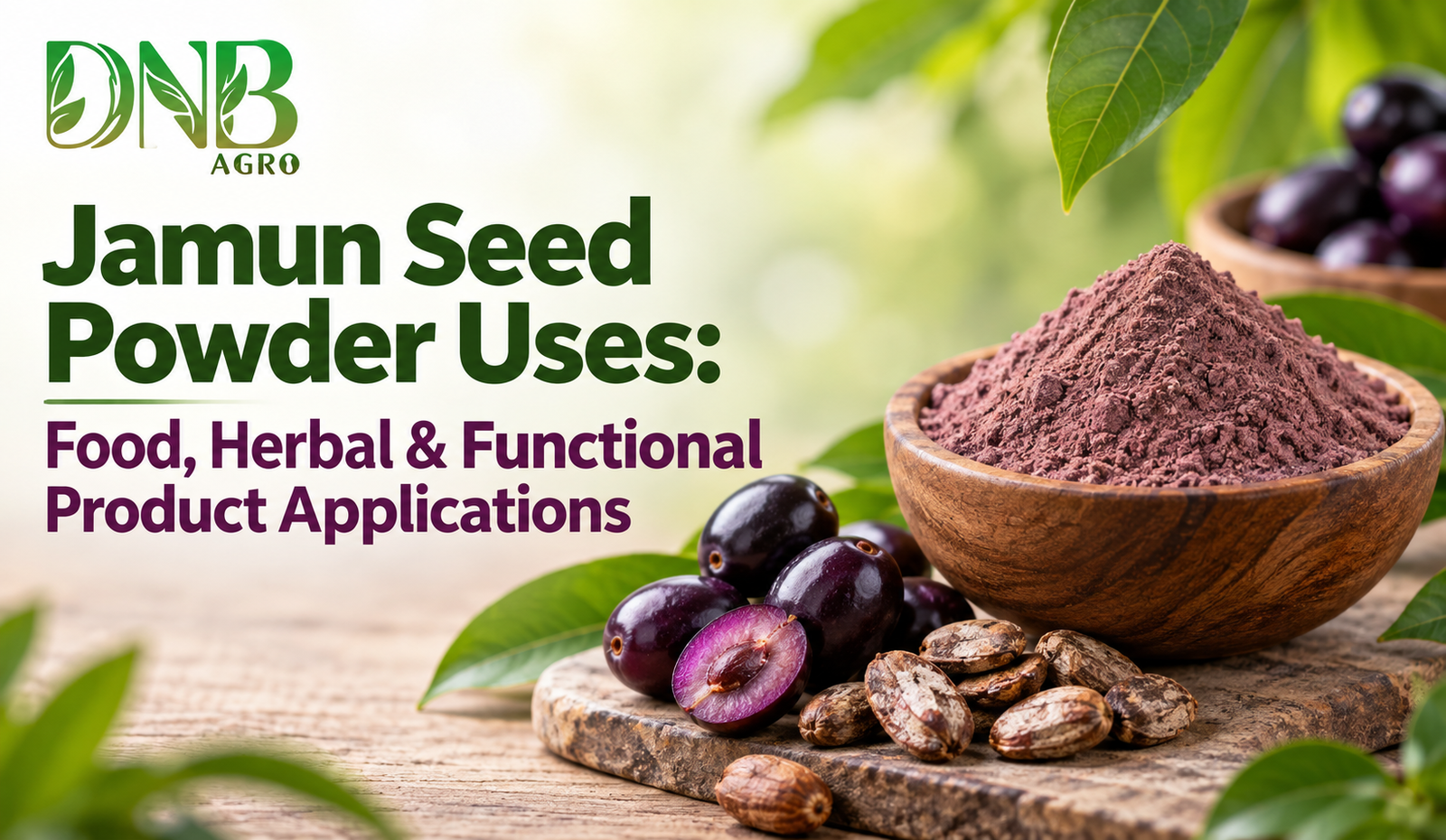
Jamun Seed Powder is made from dried and finely ground seeds of Jamun, botanically known as Syzygium cumini. It is used in traditional food preparations, herbal formulations, functional foods, beverage mixes, and dry ingredient blends. Its powdered form is easier to measure, blend, and incorporate than whole seeds.
Understanding different jamun seed powder uses can help food manufacturers, herbal product businesses, formulators, and ingredient buyers decide where the powder may fit into their products. Different jamun seed powder applications depend on particle size, flavour, moisture level, processing method, and the intended product.
What Is Jamun Seed Powder?
Jamun Seed Powder is produced by cleaning, drying, and milling Jamun seeds into a fine powder. It generally has a natural brown to light-brown appearance and an earthy, characteristic profile.
Turning the seeds into powder makes commercial use easier. It can be weighed accurately, combined with other powders, and used in dry formulations without additional grinding.
DNB Agro supplies Jamun Seed Powder as a fine, free-flowing powder with 80–100 mesh granulation, moisture of not more than 6%, and purity of at least 99%. These properties can influence different jamun seed powder applications, especially where consistent mixing and handling are important.
What Are the Main Uses of Jamun Seed Powder?
The main jamun seed powder uses include traditional food preparations, herbal formulations, functional foods, powdered beverage mixes, botanical blends, and other dry ingredient formulations. The exact application depends on the finished product, desired texture, required quantity, and processing method.
Some manufacturers use it as a single botanical ingredient, while others combine it with several plant-based powders. The uses of jamun seed powder are therefore not limited to one category. Its fine format suits applications where controlled portioning, dry blending, and ingredient distribution matter.
Jamun Seed Powder Uses in Food Products
Different jamun seed powder food applications depend on the recipe, desired flavour, and processing requirements. The powdered format is easier to incorporate than whole Jamun seeds.
Traditional Food Preparations
Jamun Seed Powder may be used in traditional preparations where Jamun seed is already part of the intended ingredient profile. The powder is easier to measure and mix, making batch preparation more practical. It can also reduce the need for additional grinding during production when the supplied particle size already suits the recipe.
Dry Food and Ingredient Blends
Jamun Seed Powder may be incorporated into multi-ingredient dry blends, botanical mixtures, powdered premixes, and specialty formulations.
Particle-size consistency matters when several dry ingredients are mixed. A fine powder can distribute more evenly and support consistent handling during batching and filling.
Selected Processed Food Formulations
Jamun Seed Powder can also be evaluated for selected processed foods where Jamun seed is required as part of the recipe. Suitability should be assessed according to taste, colour, ingredient compatibility, dosage, and processing conditions.
It is better viewed as a formulation-specific ingredient rather than something that can simply be added to every food product in the same way.
Jamun Seed Powder Herbal Applications
Jamun seed powder herbal applications mainly include products where Jamun seed is intentionally used as a botanical ingredient. The powdered form makes it convenient for dry herbal blends and multi-ingredient formulations.
Herbal Powder Blends
Jamun Seed Powder can be combined with other botanical powders when a formulation requires several plant-based ingredients. Fine granulation supports dry blending and makes weighing, portioning, and handling easier during production.
Defined particle size, moisture, and purity specifications can help formulators maintain similar characteristics across repeated production runs.
Traditional Herbal Formulations
Jamun seed has a history of use in traditional herbal preparations, and the powdered form lets manufacturers incorporate it without processing whole seeds themselves.
For this type of application, ingredient format, blending behaviour, handling, and formulation suitability are more useful considerations than unsupported disease-treatment claims.
Jamun Seed Powder for Functional Foods
Jamun seed powder for functional foods is another application area for manufacturers working with botanical ingredients. Functional foods often combine plant-based ingredients within products designed to offer characteristics beyond basic nutrition.
Functional Food Formulations
Jamun Seed Powder may be included when a manufacturer specifically wants Jamun seed as part of the ingredient profile. Its powder form makes it easier to portion and combine with other dry ingredients.
Suitability depends on the finished product, sensory profile, dosage, particle size, and processing method. Manufacturers should evaluate the powder within the actual formulation rather than assume one specification works everywhere.
Multi-Ingredient Functional Blends
Many functional-food formulations combine several botanical powders. In these products, uniform granulation, controlled moisture, purity, and batch consistency can influence processing and finished-product uniformity.
Buyers sourcing jamun seed powder for functional foods should therefore review technical specifications and supplier consistency, not just the ingredient name.
Can Jamun Seed Powder Be Used in Beverage Mixes?
Jamun Seed Powder may be used in selected powdered beverage mixes and botanical drink formulations where Jamun seed forms part of the intended blend. However, dispersibility and solubility are not the same thing.
Because Jamun Seed Powder is ground plant material, it should not automatically be described as completely soluble in water. Its behaviour can depend on particle size, mixing method, other ingredients, and the required texture.
In dry beverage mixes, a fine powder may combine more easily with other components. Manufacturers should evaluate dispersibility, sedimentation, flavour, and texture at the intended dosage. Beverage use is therefore a formulation exercise rather than simply adding powder to water.
Why Powder Characteristics Matter for Different Applications
The performance of Jamun Seed Powder can vary according to its physical and quality characteristics. Granulation, moisture, purity, and additives may all influence its suitability.
Particle Size and Granulation
Particle size can affect mixing, texture, ingredient distribution, and production handling. DNB Agro specifies 80–100 mesh granulation, with custom granulation available on request. A controlled particle size can be useful when the powder needs to blend uniformly with other finely milled ingredients.
Moisture and Powder Stability
Excess moisture can affect the storage behaviour, flowability, and handling of dry powdered ingredients. DNB Agro specifies moisture of not more than 6%. Manufacturers should still follow appropriate storage practices and their own formulation requirements.
Purity and Additives
Buyers should review purity, added colours, additives, and declared product grade. DNB Agro lists its Jamun Seed Powder as at least 99% pure and without artificial colours or additives. These details can matter when businesses require clearly defined raw-material specifications.
How Manufacturers Choose the Right Jamun Seed Powder for Their Application
Choosing Jamun Seed Powder for commercial use starts with the finished product. A powder intended for a dry herbal blend may have different requirements from one being evaluated for a functional-food or beverage formulation.
Manufacturers should review particle size, moisture specification, purity, appearance, ingredient composition, packaging, batch consistency, supplier documentation, and available custom specifications.
Before full-scale production, the powder should be evaluated within the actual formulation. This helps determine how it mixes with other ingredients, how its flavour and colour influence the product, and whether the selected granulation suits the desired texture. For repeated bulk production, consistency between supplied batches is especially important.
Storage and Handling of Jamun Seed Powder
Jamun Seed Powder should be kept in properly sealed packaging in a cool, dry environment. Exposure to excess moisture and humidity should be minimized, particularly after a package has been opened.
Manufacturers should close containers or liners promptly after use and follow supplier storage instructions. Clean, dry equipment can also help protect the powder during production.
DNB Agro lists a shelf life of 18–24 months when the powder is stored under optimal conditions. Storage practices should still follow the supplier's guidance and any requirements of the finished product.
Final Thoughts on Jamun Seed Powder Applications
The range of jamun seed powder applications includes selected food products, herbal formulations, functional foods, beverage mixes, and dry botanical blends. The best use depends on the finished product, processing method, ingredient compatibility, and required technical specification.
Understanding the uses of jamun seed powder can help formulators choose suitable quality parameters and handling practices before commercial production.
Businesses with bulk requirements can explore DNB Agro's Jamun Seed Powder for specifications and supply information. Buyers with formulation-specific requirements or bulk enquiries can also contact DNB Agro directly.
Frequently Asked Questions About Jamun Seed Powder Uses
What are the main uses of Jamun Seed Powder?
The main jamun seed powder uses include selected food formulations, herbal powder blends, functional foods, beverage mixes, and dry botanical formulations. The exact application depends on the recipe, required particle size, flavour profile, and processing conditions.
Is Jamun Seed Powder used in food products?
Yes. Jamun seed powder food applications can include traditional preparations, dry food blends, botanical premixes, and selected processed formulations where Jamun seed is part of the recipe. Manufacturers should evaluate taste, texture, dosage, and processing compatibility for each product.
Can Jamun Seed Powder be used in herbal formulations?
Yes. Common jamun seed powder herbal applications include botanical powder blends and traditional herbal formulations that require Jamun seed as an ingredient. Fine granulation can make the powder easier to weigh, blend, and handle during manufacturing.
Can Jamun Seed Powder be used in functional foods?
Yes. Jamun seed powder for functional foods may be used where Jamun seed is part of the intended botanical ingredient profile. Formulators should consider particle size, moisture, purity, sensory characteristics, and compatibility with other ingredients.
What should manufacturers check when buying Jamun Seed Powder?
Manufacturers should review purity, granulation, moisture level, appearance, additives, packaging, batch consistency, supplier documentation, and available order quantities. The selected specification should suit the intended food, herbal, beverage, or functional-food application.